Wednesday, October 6, 2010

Up Next: Geometry Wars


Ah, Geometry Wars. This was one of the first games available on XBOX LIVE Arcade when the 360 came out. I remember reading blogs about people who were dissatisfied with the system's launch lineup but were justifying their purchase because of this simple little shooter. 

For those who have never played a Geometry Wars game it's very similar to Robotron or Smash TV. Using two joysticks, one to move your character and one to direct your fire, you can very tactically take out your enemies. Here's a video to make it even clearer what this game's about:


That guy is insane. Anyway, this the first game that has a "Needs Assessment" label on it for completion. Geometry Wars doesn't have an end state, but rather just a high score like many of the older arcade games. There aren't even different levels - just one screen of consistently harder and faster enemies. So my goal for this game is to reach 1 million points. I think the highest I've gotten is about 300,000 so I have a long way to go. Luckily this is a game that I can space out to and play for hours. Hopefully I can get up there in a week or so. I just may not be that good...

Well, let's go for it!

Geometry Wars: Retro Evolved for XBOX 360. Let's do it.

.

Monday, October 4, 2010

Review: Zelda II The Adventure of Link


The Zelda franchise is perhaps one of the most respected and well known in the video game industry. Everyone has played at least one Zelda game, and they are often the benchmark of quality for a generation of gamers. Zelda II is a bit of an odd bird though. It doesn't fit the mold of the top down, exploration friendly aspects of its brethren.  Zelda fans often denounce this one as rubbish and not part of the Zelda they know. And while I agree that it's a radical departure from the tried and true Zelda formula, that doesn't make it a bad game. In the same way that DK Country would be remembered as 10x worse than it was if it didn't have the DK license, Zelda II would have been more highly regarded if it wasn't a Zelda game. 

Story

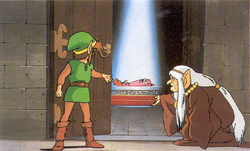
As is the case with most NES games, the story is told almost entirely in the manual and very little happens in game. Here's the gist - Ganon is dead after the first game, but Zelda is in a deep sleep and you need to go outand find the Triforce again to wake her up. But the story isn't purely about exposition - it's also place and atmosphere. Zelda has always been about exploration. Miyamoto even said that the area around the first temple in the original Zelda game was modeled around an area he used to explore as a kid. Even though the method of seeking out treasures and secrets is slightly different in this game, you still feel that sense of adventure and exploration throughout. 

Like the first game, you meet people who give you help and clues as to some of the secrets in the world, but they are no longer cave dwellers - people now live in towns scattered throughout Hyrule. And while the writer of this dialogue isn't gonna win the nobel prize for literature, the limited text that was uttered from the townspeople was efficient and memorable. Who can forget "I AM ERROR" or "WHEN ALL ELSE FAILS USE FIRE"? 

Like most NES games, the story isn't super important to the overall experience but Nintendo did an admirable job of making the world of Hyrule feel like a real place inhabited by real people. 

Design
Zelda II is one of the more unique games in the NES library in that it borrows elements from a lot of different sources.  The overworld is structured like a Final Fantasy game where you fight battles on a separate screen from the map itself. Battles take place as side scrolling sword fights, combining elements of Mario Bros and Ninja Gaiden. The tiered temple structure is the one big similarity to the original game and to the games that followed it. And finally, you can level up your attack, life and magic power using experience points like other RPGs of the time. 

Now, that sounds like a mess, but it all fits together so perfectly that the experience just sings this beautiful four part harmony of game design. Most of the time. There are a few flat notes and missed cues to deal with as well. 

The beginning. Get used to this screen. You'll see it a lot.

As you probably know, the difficulty is insane - or at least the perception is that its insane. One of the most controversial elements of Zelda II is the fact that you only have three lives, and once you lose all three - you go all the way back to the beginning. Screw you. No mercy. Start over. Now, your progress isn't lost however. You retain all the items and spells that you've acquired, but you just have to walk all the way back to what you were doing. And while there are parts that are really challenging, I think the perception is that the game is much harder than it is, when in fact it's actually just annoying and monotonous. 

The other unnecessary and awful element was the bottomless pits. A bane on the design of almost every NES game, the bottomless pit spells instant death, and it was the worst part of Zelda II. Couple the threat of instantly losing one of your precious lives to a stupid hole with the stupid "get hit and get knocked back a foot" mechanic, and you have a controller spiking problem. 

As was already stated though, the sense of exploration and the feeling of place was absolutely perfect. One of my favorite things about video games is their ability to take you to a different world. I would love a version of this game where your only objective was to explore Hyrule. No fighting, no boss battles, just find everything you can. The exploration of the overworld and each of the seven temples was by far my favorite aspect of the game. 

The design may seem like a crockpot full of mis-matched ingredients, but even though there are annoying and frustrating elements, when the credits roll, you feel like you felled a monstrous beast, designed by gods.

Gameplay
The gameplay is the most interesting and unique element of the game. The main mechanic revolves around stabbing with your sword and blocking with your shield. By standing up or ducking, you can adjust the position of your sword and shield and the developers really optimized this aspect of the game by throwing tons of different enemies at you that both attack and block the high and low positions. The knights in the temples are the most well known and battles with certain types of enemies that took advantage of the high low mechanic could sometimes take an upwards of one or two minutes. 

 Sword fight.

In addition to stabbing high and low, you also gain access to an up thrust and down thrust later in the game. These allow you to attack directly above and beneath you and the attacks are extremely helpful in certain situations. And finally, your magic spells are the last part of your arsenal. You learn magic like SHIELD which reduces damage, FIRE which allows you to shoot fire from your sword, and LIFE which will restore a portion of your health along with a handful of others. And while you do acquire gadgets and gizmos throughout your journey like the raft and the power glove, they are used more automatically, becoming more of an upgrade to your character than a tangible, usable piece of equipment. The spells are where you will find yourself relying most heavily on. In the final temple, I was casting different spells in every room. Although I wish that some of the spells became permanent upgrades later in the game. The REFLECT spell particularly, which allowed you to bounce projectiles back at enemies, would have been a nice permanent upgrade to your shield. Otherwise in temples with a lot of projectile based enemies, you would constantly have to cast REFLECT in every room. 

The best thing about it though was when you were surrounded by enemies all launching projectiles at you from opposite directions, and you were able to take all of them out without sustaining a single scratch. It's the same thing I liked about Final Fantasy XIII - fighting is a skill at which you actually improve as you play. Your character not only gets stronger, but you get better and faster as you practice. It's a great sense of triumph when you take out a bunch of enemies, because you feel like you alone are responsible for their demise. 

Presentation
When this game was released, graphics were pretty much the biggest selling point of a game. No matter how great the game or story was, if the graphics were muddy or unimpressive, chances are people probably weren't going to buy it. I think the intention then, of making a side scrolling Zelda game was to give Link a larger sprite model which allowed the designers to give him a little more detail and make boss characters larger than life. 

And as far as NES games go, the graphics hold up fairly well. The animations are smooth and consistent. The enemies are well designed and extremely varied - to the point where each new region on the map had a different enemy type, which really added to the sense of place that's so important. But as good as the graphics were, the music is the real standout in this game. 

As with other Zelda games, the music is fantastic. But it's also a bit of an odd bird in the mix. The music from Zelda games have a consistent feel. A kind of woodsy, organic, exploration feel to them, but Adventure of Link had a completely different tone altogether. The midi instrument that was used in the composition of most of the songs is so distinctive that I can't hear that tone without thinking of this game. It's sort of a Middle East high pitched flute kind of sound that's hard to describe, but again - this distinguishes it from the first game and gives, yet again, a very strong sense of place to this other area of Hyrule. In fact if you look at this picture, you can see that the southern most tip of the Zelda II Hyrule is the entire Zelda I map:

Notice the graveyard on the left and the shape and position of the lakes in the middle.

All in all, this is certainly a strange Zelda game. It doesn't hold your hand the way other Zelda games do. The combat is fast and frantic and the lives system is strange and seemingly unnecessary, but if you play thing thing through from beginning to end, without comparing it to the other games in the Zelda pedigree, you will enjoy it. I promise.
 

Review in Ten Words or Less
Not quite Zelda enough, but definitely good enough.

.

Finished: Zelda II The Adventure of Link

I did it!

Playtime: 7:15
Levels: Attack 8, Magic 8, Life 8
Found: Everything except one Heart Container. 

YES!!! This is the most excited I've been so far about beating a game. I've had Zelda II almost as long as I've had Mario Bros, so it has taunted me for just as long with it's obscene difficulty. But man, what a great game.

In the end, I beat shadow link using the cheap "duck in the corner and just keep stabbing" move, but I didn't care. I finally beat Zelda II. The Murray lineage will be proud.


 Thanks a million? Really? Well, at least it's spelled right.

 .

Wednesday, September 29, 2010

Halfway There...Zelda II: The Adventure of Link


It's just as I remember it. Finding Bagu's house in the woods to give his letter to the river man. Waking up the sleeping bat in the house. Getting the water from the fountain to give to the lady so I can get the Fire spell. " I AM ERROR." It's all right at the tip of my memory.

As the Angry Video Game Nerd noted in his review of this game, the difficulty curve spikes REALLY early in the game. After the relatively simple first temple, the game throws you to the wolves and says "F&*K YOU!"

In fact, I think the hardest temple in the game is the second one. You don't have the LIFE spell yet. Your life, magic and sword skills are dramatically underpowered compared to the strength of your enemies. Every other Temple I beat without using a continue, but for the second temple, I had to continue probably five or six times. Directly after that, you have to get through Death Mountain, by far the most difficult section of the game. This is a maze of caves and the enemies in these caves aren't effing around. They will ruin you until you level up a bit. So really, the game almost requires you to grind right after the first level in the game. That's insane. Even the first Final Fantasy didn't force you to grind so early in the game.

After that, the game eases up a little bit and the difficulty becomes more cerebral. Your goals and puzzles become more abstract. Finding your next objective and making your way to each temple becomes a little more difficult to figure out. Not to say that the physical challenge isn't still present, but it becomes a lot easier once you level up. In fact, there are times when the challenge from enemies is pitch perfect. Because the combat is much deeper in this game than in any other Zelda title, it takes a bit of practice to get good at stabbing and blocking with the right timing, and when you're surrounded by enemies and manage to block three projectiles from both directions at both a high and low level AND take out four enemies in a matter of seconds, you feel like a god.

I'm loving this (potentially) final playthrough of Zelda II. It is a fantastic game that is drastically underrated. I recommend you give it another shot without viewing it through the "Zelda lens". Take it on it's own merits. You'll love it.

Sunday, September 26, 2010

Up Next: Zelda II The Adventure of Link


The black sheep of the Zelda franchise, Zelda II was my first experience in the land of Hyrule and remains to this day to be the only game in the series I have never beaten. This isn't because of any dislike for the game but purely due to the difficulty. It is without a doubt the hardest Zelda game in existence. The biggest issue is that when you lose your three lives, you're sent back to the beginning of the game. You keep all your items and keys and whatnot, but the journey to each temple is sometimes harder than the temple itself. I often wind up sacrificing one or two lives on the way to my destination. 

For this reason, and because it doesn't fit the mold of the other Zelda games, The Adventure of Link gets a pretty bad rap. Most people can't stand it and herald it as the worst Zelda game in existence. And while it's certainly not my favorite Zelda game (that distinction goes to Majora's Mask) it still has some great elements and is a genuinely unique game. 

Now despite not beating it, I have seen the end of this game several times. As a kid, this game was a little beyond my ability, but my dad was obsessed with it. I watched him beat it when I was about eight. I remember trying to figure out how to beat shadow link with him and I had heard from a kid at school that you had to duck in the corner and just keep stabbing. I couldn't wait to tell my dad, so over dinner I spilled the news and we both shoveled the remaining food into our mouths and rushed up to my room and turned on the NES. I sat on the floor with my legs crossed, entranced in the possibility of seeing the end of the game. Cheering my father's every littler victory on the way to the final temple. He beat that first giant blue hawk thing and then, out comes shadow link. We both held our breath. My dad rushed Link into the left corner, knelt down and mashed the B button. Shadow Link was finished. My memory of sharing that moment with my dad is more tangible than actually seeing the end of the game. In fact, I don't think I remember what happened after that.

So now it's my turn. I have to carry on the Murray legacy and finish the same way my father did, and his father before that, and his before that. We Murray men have a long history of beating Zelda II. All the way back to the colonial settlers. For real. 

Zelda II: The Adventure of Link for NES. Let's do it.

Saturday, September 25, 2010

Review: Harry Potter and the Chamber of Secrets


There's a mantra almost as old as the video game industry itself:

"Licensed games are never good."

And while there are certainly exceptions to the rule, games based on movies are generally built very quickly to coincide with the release of the film. Quality, story and ingenuity are at the bottom of the priority list when it comes to games like this. Kids will buy them because they just saw the movie and they are psyched about it. Once they pay their $60, it doesn't matter how good the game is. The publisher made their money.

Harry Potter and the Chamber of Secrets has too many faults for it to excluded from the list of "rushed to market" licensed games. That being said, the team behind this one put at least a little heart into the final product.

Story
This is one of the games shortcomings. If you read the book, or saw the movie, or both - you will be extremely let down by the way this game's story progresses. For a game whose title alone infers mystery and wonder, there are maybe four missions associated with the chamber of secrets - including the final battle in the chamber. The rest of the game focuses on meandering around the castle, going to class, fetch quests and other drab tasks that suck the pacing out the window.

Additionally, the way the story is delivered is so haphazard and inconsistent that you feel like this project was completed by three completely separate teams that didn't talk to each other. Sometimes the story is delivered through cutscenes with atrocious writing and acting. Sometimes the camera stays locked in one spot while a portion of the (admittedly great) audio book plays. Sometimes you're given no story at all even though you're expecting something.

Yeah, me either. This story blows.


After the final battle, you won't feel like you accomplished much. There is no build up and no real motivation from the story that pushes you forward. The recognizable movie elements were so neutered and coated with candy that they didn't even make sense. For the most part it's a series of random tasks that just happen to include some mysterious chamber, that may or may not contain a secret or two.

Gameplay/Design
OK - while this isn't saying much, the gameplay and design were the game's strongest assets. As is the case with many licensed games, the developers took an existing, successful formula and slapped the the treatment over it. In the case of HPatCoS the borrowed formula was Zelda, but they did manage to give the game it's own distinct feel as well.

Assignable Buttons


 The most obvious Zelda element is the assignable buttons. As you progress through your game, Harry will discover new spells like Incendio (fire spell), Exelliarmus (reflect spell - not a disarming spell), Avifors (transforming spell), Scurge (de-gooify spell) and so on. Each of these can be assigned to a one of the face buttons like you would assign your items and gadgets in Zelda. The other big Zelda element is the target lock on - pressing and holding R1 will lock the camera onto your enemy and direct your spell at that target. This is fairly clunky in implementation though as you already have to be facing the target to lock onto it, which effectively eliminates the need for it altogether.

The majority game is broken down into three distinct segments: Classroom dungeouns, castle exploration, and Quiddich matches.

The classroom dungeons are similar to the temples in Zelda, though much shorter and less involved. Each of the four could be bested in about 30 minutes. At the heart of each dungeon was a book that awarded you a new spell, sometimes you got to use this spell to escape from the dungeon and fight a boss, sometimes you didn't. And really, I would have preferred the game to have no bosses, or any fighting at all for that matter.

The exploration aspect of the game was so joyous that the fighting just seemed to be a roadblock to getting back to sneaking around the castle and finding hidden magical items. The most common find is one of the 101 Witches and Wizard collectible trading cards. For every 10 you found, your health meter would expand a bit kinda like the heart pieces in - say it with me - Zelda. You could also trade these cards with other Hogwarts kids, but that aspect felt pretty unnecessary.

There were little nooks and crannies hidden all over the castle and looking for and eventually finding them was one of my favorite parts of the game. If you do your exploring at night though, things become a little more difficult.

The game is broken into 6 days and 6 nights. During the day you do your classes and Quiddich and stuff, and at night you do the rebellious stuff. Sneaking into the restricted section of the library, taking polyjuice potion and turning into Doyle to get the skinny on Malfoy, sneaking out to Hagrid's hut and other various bouts of mischief. However these cooler tasks come with greater risk. There are hall monitors roaming the halls of the castle and if you're caught by one, they deduct five house points from Gryffindor, and you're sent back to the start of the room. All this sneaky stuff is cool in theory, but really difficult and frustrating in execution. You didn't have much control over the camera, nor did you have a radar screen like you would in Metal Gear - so trying to figure out where the hall monitors were and which way they were facing was really difficult, and I would often just blindly get through the room on a trial and error attempt.

There is one more method of exploration - by broomstick. About 1/4 of the way into the game you're given access to your Nimbus 2000 and from there you can fly around the entirety of the exterior of Hogwarts Castle. This was by far the best part of the game - and while there really wasn't much to find outside, the design team just nailed the broom controls to make it such a fun thing to do. Every time I found myself outside for a mission, I would always hop on my broom and take a ride around the castle. But exploring isn't the only thing you can do on broomback - flying practice and Quiddich are also available, but not nearly as fun.

Ever play Superman 64? Remember flying through rings? Yeah - that's what Quiddich is. You fly through rings and try to catch the snitch. You don't have the option to play any other positions, which is kind of a let down, but it's still a nice addition to the game.

One more thing I have to mention, and this is my biggest gripe about the game: load times. They are atrocious. While the interior of Hogwarts is pretty large and complex, it shouldn't take a full 20 seconds to load every time you open a door. My final playtime was about six hours and I would venture a guess that probably a solid hour was that was spent waiting in loading screens. Unbelievable.

 Come on...come on!!

If the loading times weren't there, or even if they were cut in half, it would bring the game up a full letter grade for me. All the elements of a solid game are there, and the broomstick flying is one of my most memorable experiences in the adventure so far. But the load times just choked all the fun out of the experience.

Presentation
All things considering, the game looks pretty good for something that was rushed to market in 2002. Hogwarts Castle is modeled very well, the kids look like the kids from the movie and the spells and special effects animate the way they're supposed to. On the other hand there were what I call "herky jerky" moments in the presentation - especially during cutscenes. There never seemed to be a proper conclusion to a scene and they all just kinda chopped themselves off at the end. Even the final scene of the game ended abruptly and awkwardly shoved me back to the main menu.

The sound design is pretty atrocious overall. They didn't license the wonderful music from the HP movies and while the music was OK, it was a disapointment to not have the main Harry theme. The voice acting is really where the sound showed its diseased underbelly. Again, not getting any actors from the films, the stand-in cast had no business acting anywhere at any time. Once in a while, when you were involved in a lighthearted mission, the acting didn't stand out as bad, but as soon as there was any gravity to the situation, the acting stuck out like a sore thumb. There was no range of emotion in any of the voices - the actor playing Ron would deliver these two lines with the same exact jolly tone:

"Hi Harry! Let's go to the Quiddich stadium for your match against Slytherin"
"Harry! You were almost eaten alive in the Chamber of Secrets! Thanks for saving Ginny, my sister, by the way!"

Decent graphics, but the voice acting and music brought the presentation way down.

Stuff I Liked:
  • Castle exploration
  • Broom flying
  • Zelda elements
Stuff I Hated
  • Atrocious voice acting/writing
  • Clumsy battle controls
  • LOAD TIMES! 
Just as I predicted, in the end the game was "edible". I didn't throw up as soon as it touched my tongue, but I didn't say "Oh man! Call the chef over! I need to give him a tip!" There were good elements, there were terrible elements. This spirited attempt at making a fun licensed game fell just a bit short.

Review in Ten Words or Less:
Play it only if you get it for free

Friday, September 24, 2010

Finished: Harry Potter and the Chamber of Secrets

 I did it...


Final Hour Count: About 6 Hours
House Cup: Slytherin
Quiddich Cup: Gryffindor

Cross another mediocre game off my list.